← All exhibits

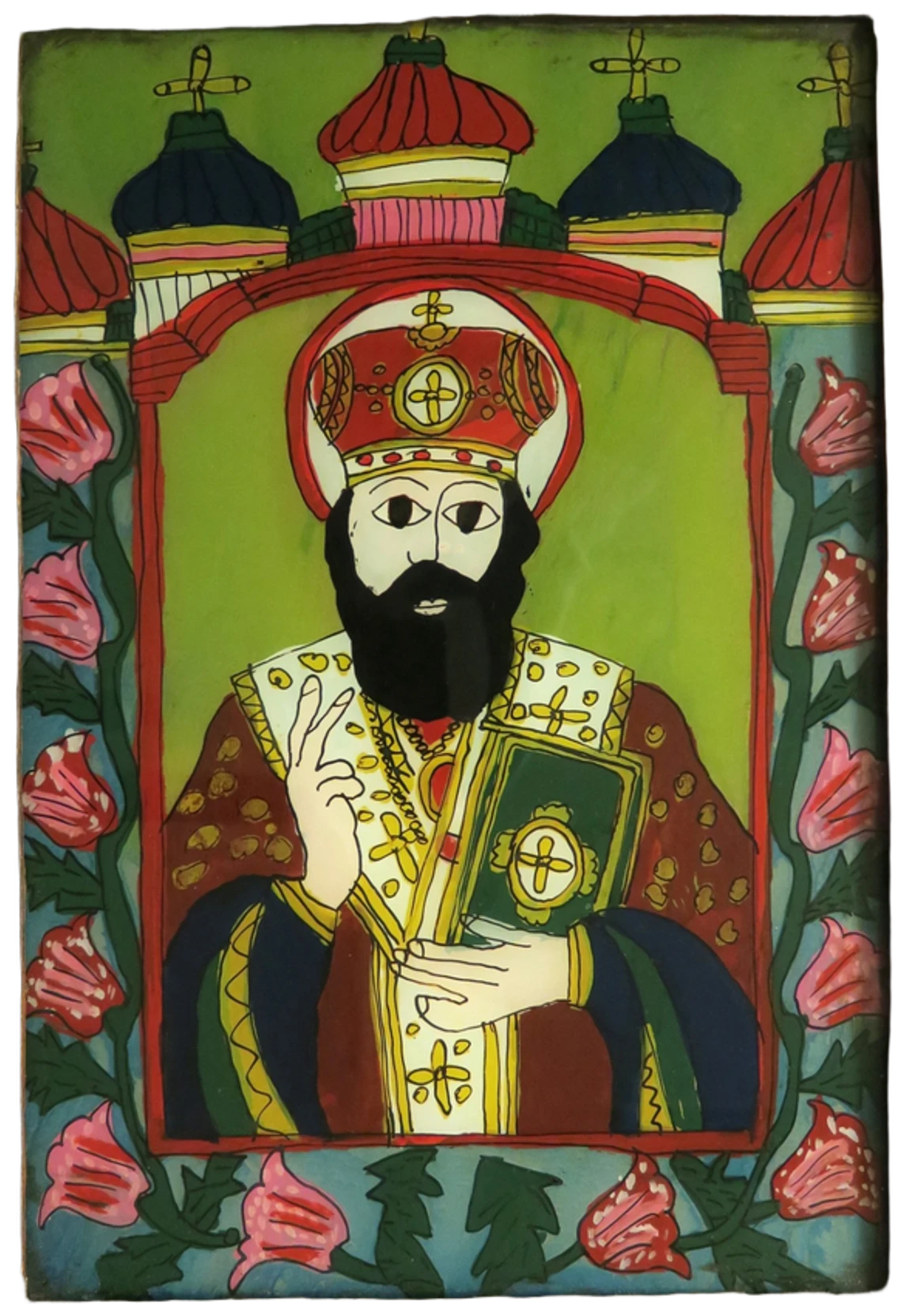
Holy Bishop

Transylvania, 19th century, reverse glass painting, glass, oil paint, height 43.5 cm, width 31.5 cm

The reverse glass icon shows an unnamed holy bishop in a frontal half-length portrait. He wears liturgical vestments with an omophorion and a richly decorated mitre. In his left hand he holds a book of the Gospels adorned with a cross, while his right hand is raised in a gesture of blessing. Five stylized church domes rise behind a red arch. On both sides and along the lower edge, pink blossoms with lush foliage, typical of this genre of imagery, frame the scene.

The work dates from the 19th century and originates from Transylvania, where an independent folk tradition of reverse glass painting developed. Peasants and craftsmen created such icons primarily for domestic devotion. Typical features include clear black contour lines, bright areas of color, and simplified forms. As an inscription naming the saint is missing, it remains open whether Nicholas of Myra, Basil the Great, or another revered Church Father is depicted.
Background

1 / 2
  • Miter
    Term

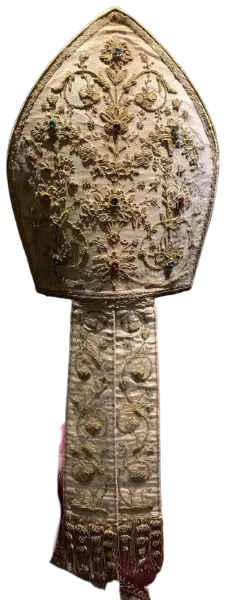
    Miter

    1 exhibit

    Two steeply rising peaks and two hanging fabric ribbons immediately reveal the rank of the depicted figure in old paintings. For centuries, the miter has crowned the heads of Christian bishops during solemn church services.

  • Omophorion
    Term

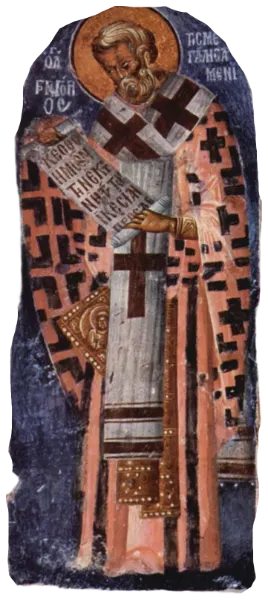
    Omophorion

    1 exhibit

    Across the shoulders of the painted bishops lies a broad white band embroidered with dark crosses. In the Eastern Churches, this cloth—the omophorion—marks the office of bishop and distinguishes the dignitary from ordinary priests at first glance.

Provenance and rights

Collection
Reverse Glass Icons
Acquisition
Donated by Reiner Zerlin, Brühl (Rhineland), 2019
Image
Ikonen-Museum Recklinghausen · CC BY-NC-SA
Background
Miter: Federigo Federighi, Wikimedia Commons · CC BY-SAOmophorion: Meister der Aphentico-Kirche in Mistra, Wikimedia Commons · Public Domain Mark