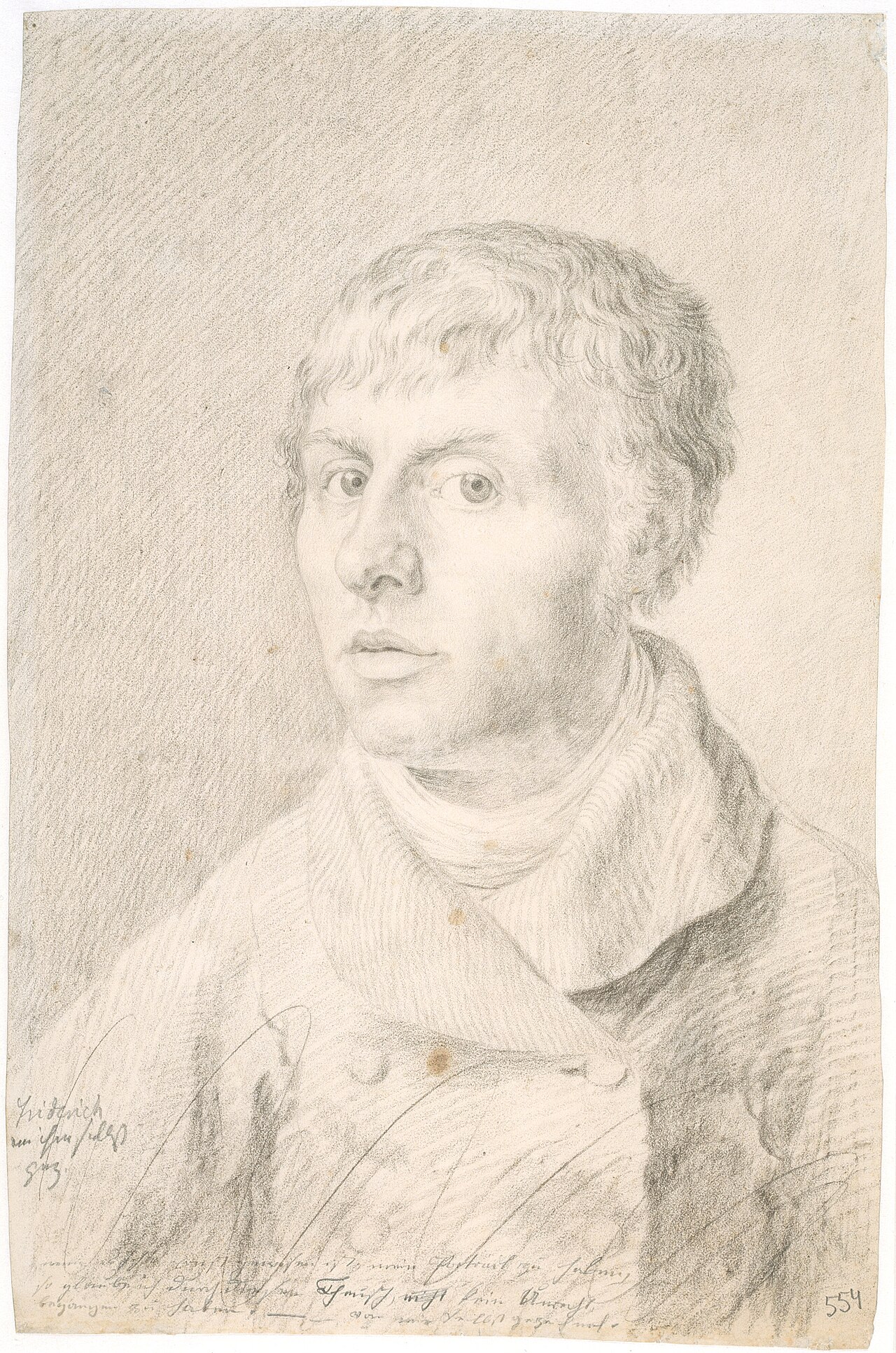
Caspar David Friedrich
Life
- Born
- 1774
- Died
- 1840
- Active in
- Greifswald, Copenhagen, Dresden
Biography
Caspar David Friedrich was the most important painter of German Romanticism. With his melancholic and symbolic depictions of landscapes, he created an entirely new visual language that combined the experience of nature with a spiritual search for meaning.
Life
Caspar David Friedrich was born in Greifswald, Pomerania, and received his first drawing lessons there. From 1794 to 1798, he studied at the renowned art academy in Copenhagen before settling permanently in Dresden. Numerous walking tours through the landscapes of Rügen, Saxon Switzerland, the Harz Mountains, and the Giant Mountains shaped his understanding of nature and provided a rich reservoir for his later pictorial compositions.
Work
Friedrich elevated landscape painting to an autonomous vehicle for profound religious and philosophical sentiments. His works are characterized by strict geometric composition, subtle handling of light, and precise studies of nature, which he assembled in the studio into heightened allegories. Motifs such as fog, ruins, cemeteries, the sea, and solitary figures seen from behind became unmistakable hallmarks of his art.
Impact
Although Friedrich celebrated great success in the 1810s and was patronized by the Prussian royal family, contemporary audiences lost interest in his quiet melancholy during the late Biedermeier period. He died impoverished and largely forgotten in Dresden in 1840. It was not until the beginning of the 20th century that Friedrich was rediscovered as one of the most important and profound innovators of modern landscape art.