Miter
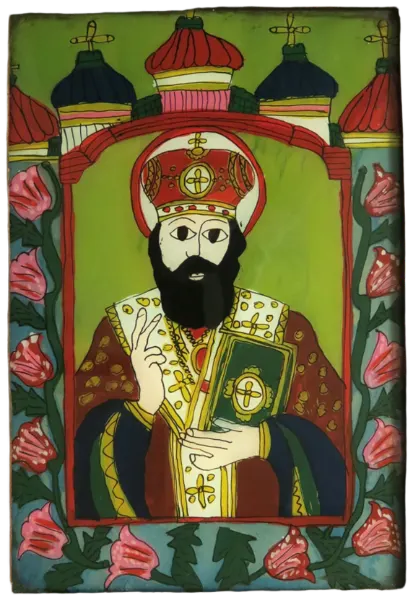
Two steeply rising peaks and two hanging fabric ribbons immediately reveal the rank of the depicted figure in old paintings. For centuries, the miter has crowned the heads of Christian bishops during solemn church services. In folk art as well, such as in Transylvanian reverse-glass paintings, this distinctive head covering identifies a saint at first glance as the shepherd of his congregation.
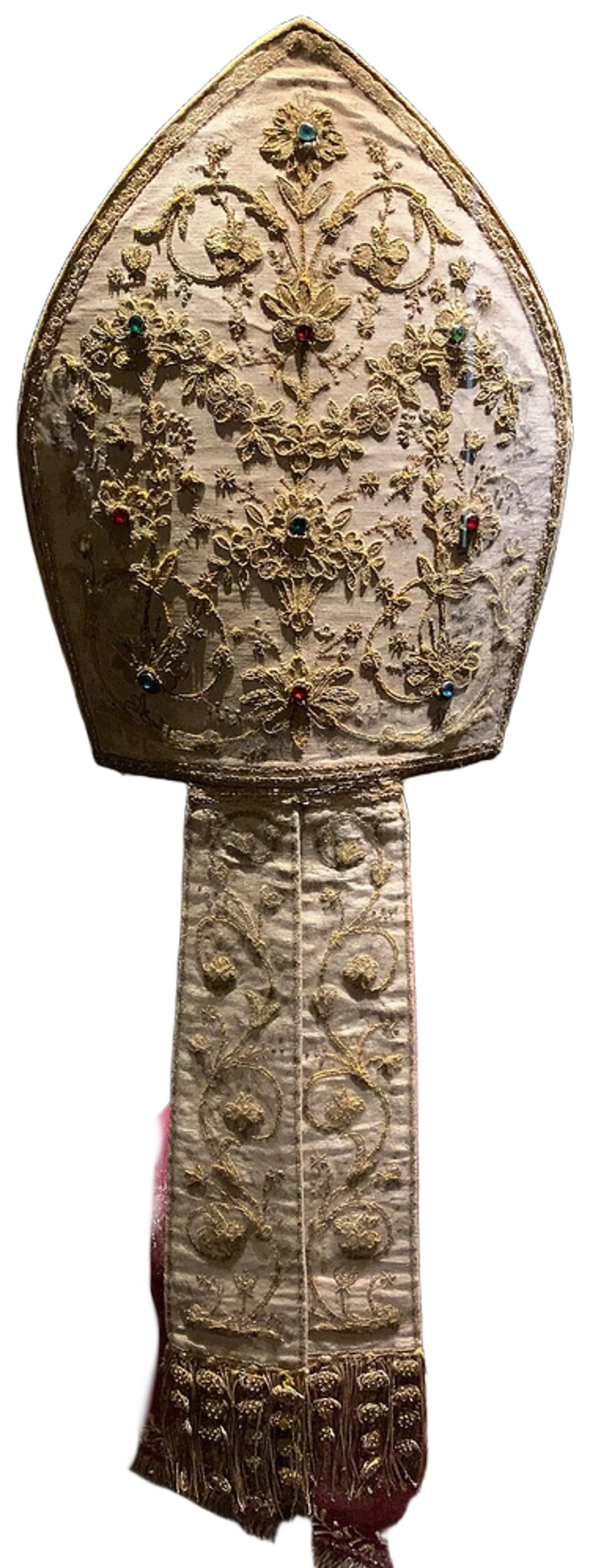
In the first millennium, ecclesiastical dignitaries wore simple round caps or headbands during celebrations. It was not until around the eleventh century that a distinct head covering emerged in Rome, which initially had a rounded dome. Clergy soon pressed the cap inward from the sides or from the front, creating two characteristic little horns. From this simple division, two towering triangles made of stiffened linen, silk, or gold brocade developed over the centuries. Two ribbons remained attached to the back edge, known as lappets, which fall over the nape of the neck onto the shoulders. The appearance changed continuously, but the two-peaked outline remained. (97 words) [Attention: count words]
In the liturgy, the bishop puts on the headdress only at certain moments, while removing it out of reverence during prayer before the altar. Artisans decorated the most solemn pieces with pearls, precious stones, and elaborate embroidery. Theological interpreters saw the two peaks as a symbol of the Old and New Testaments, both of which the officeholder is meant to proclaim equally. In painting, the textile helped ordinary believers recognize a figure without an inscription. A bishop on a glass icon often wore simple vestments, but the towering headdress made his authority and dignity unmistakable. To this day, it remains one of the unmistakable insignia of the successors to the apostles. (100 words)
Related in the museum
Provenance and rights
- Images
- Main image: Federigo Federighi, Wikimedia Commons · CC BY-SAImage 2: Karl Joseph Ruff d. Ä. (1815–1896), Winklarn, Wikimedia Commons · Public Domain Mark
Federigo Federighi, Wikimedia Commons · CC BY-SA
Sign of the Pastoral Office
Karl Joseph Ruff d. Ä. (1815–1896), Winklarn, Wikimedia Commons · Public Domain Mark